BLANC

Adaptive Temporal Scheduling for Sign Language Production
Under Review
Youngmin Kim1, Seoyeong Hwang2, Sujung Hong1, Seong Jae Hwang1
1Yonsei University · 2Ewha Womans University

Text-to-sign results on the same input sentence: ground truth, BLANC (Ours), and gloss-free baselines.

TL;DR

BLANC generates signing motion from text by tokenizing the body and both hands at different temporal rates (MRVQ) and generating motion in variable-duration blocks whose lengths are predicted by a Latent Articulatory Clock, learned without gloss annotations. It achieves state-of-the-art gloss-free SLP on PHOENIX-2014T and CSL-Daily.

9.85
Back-translation BLEU-4 on PHOENIX-2014T
best gloss-free baseline: 6.44
1.48
Hand DTW-PA-JPE on PHOENIX-2014T
best gloss-free baseline: 1.58
โˆ’45%
Body reconstruction error with MRVQ on CSL-Daily
11.80 vs. 21.56 (SOKE)
+12.7 pp
Boundary precision vs. uniform blocks on CSL-Daily
60.3 vs. 47.6

Abstract

Sign language production (SLP) aims to synthesize expressive signing motion from written text. Modeling signing motion presents two key temporal challenges. First, fine-grained hand articulations demand higher temporal resolution than relatively slower body movements. Second, signing events unfold over variable durations, calling for adaptive temporal scheduling during generation.

To address these challenges, we first introduce a Multi-Rate Vector Quantizer (MRVQ), an articulation-decoupled motion tokenizer that represents the body and both hands as separate discrete streams at distinct temporal resolutions. Building on this representation, we propose Blanc (BLock-wise Adaptive diffusioN with Articulatory Clock), a gloss-free SLP framework that generates variable-duration motion blocks causally while denoising tokens in parallel within each block. At its core, a Latent Articulatory Clock (LAC) learns temporal structure from multi-scale motion-derived partitions to predict block durations and sequence termination during generation. We further introduce inference-time body-conditioned hand refinement to improve coordination across articulators.

Extensive experiments on PHOENIX-2014T and CSL-Daily demonstrate that Blanc achieves state-of-the-art performance in sign language production.

Two Temporal Challenges

Signing is realized through coordinated body and hand motion that evolves at different rates and over variable durations.

Challenge 1 ยท Representation

Hands move faster than the body

With a shared token rate, coarse tokenization discards hand detail, while fine tokenization inflates the token budget for every articulator.

Challenge 2 ยท Generation

Signing events have variable durations

Fixed-size blocks impose uniform generation intervals that can split coherent articulations or merge distinct motion phases.

2.47ร—
higher hand linear velocity
2.18ร—
higher hand angular velocity
r = 4 / 2
body / hand temporal compression
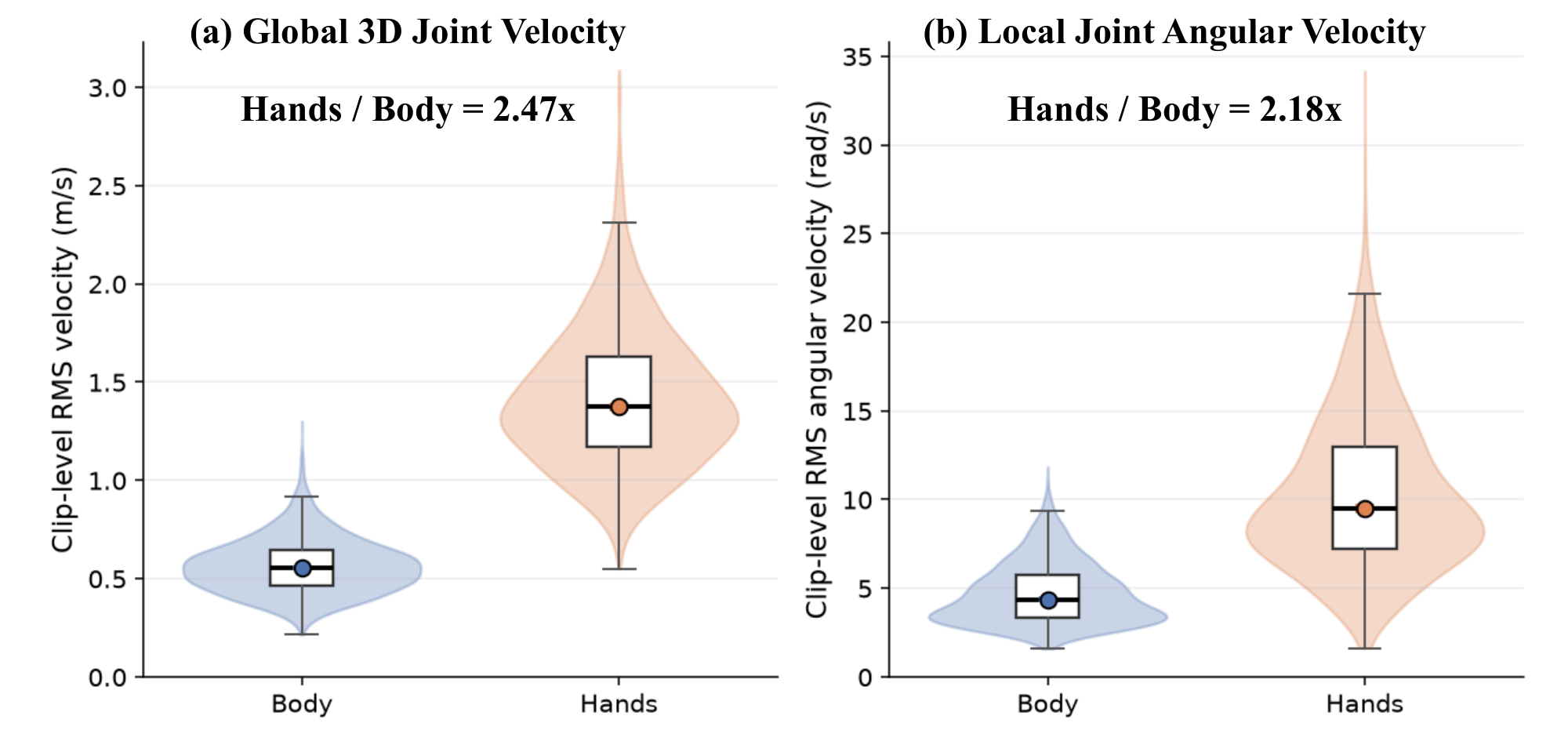
Velocity analysis showing hands move faster than body in both 3D joint space and angular space.
Velocity analysis on PHOENIX-2014T and CSL-Daily. Hands exhibit higher clip-level RMS velocity than the body in global 3D joint space (a) and local angular space (b), motivating separate temporal rates for body and hand motion.
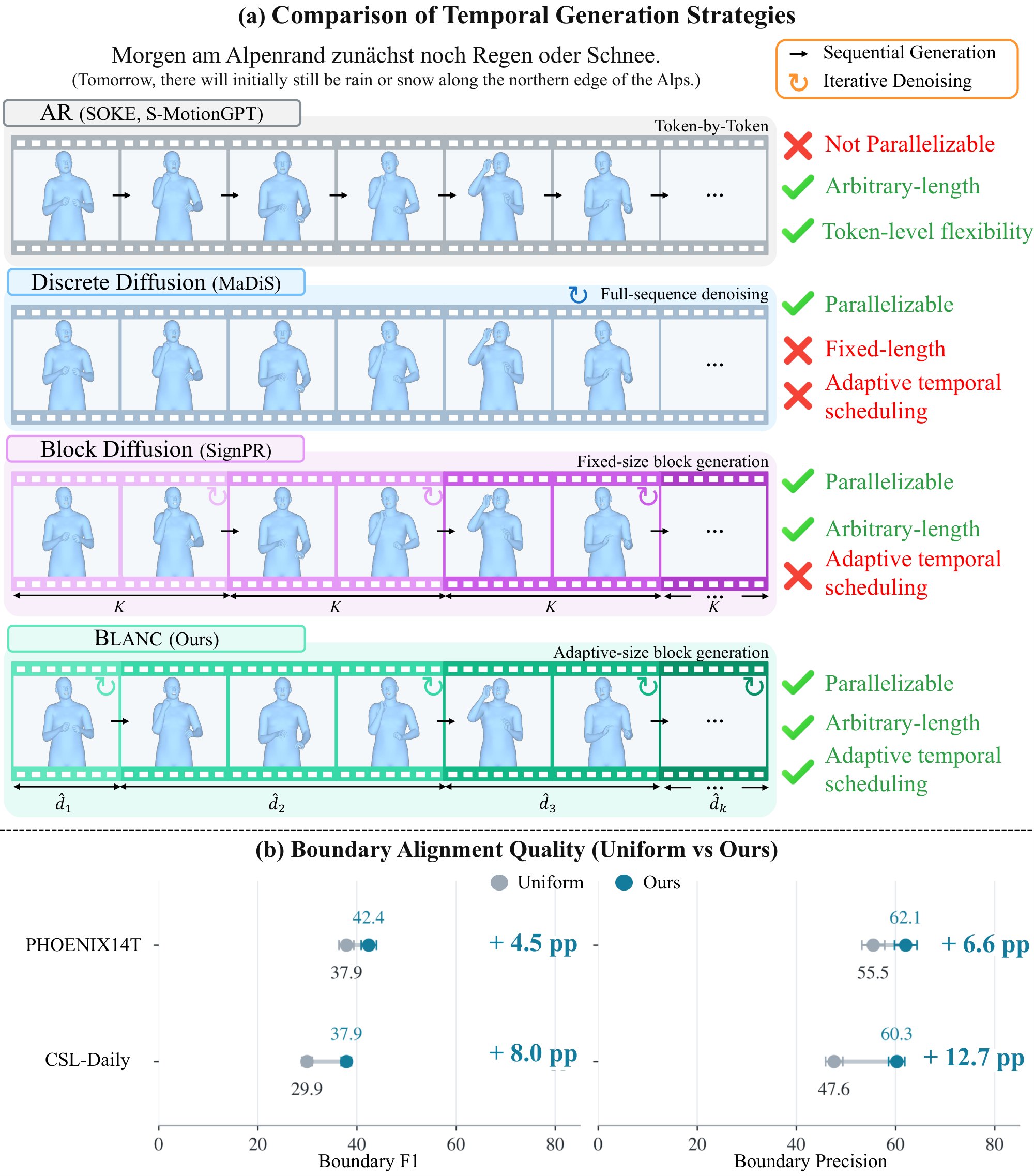
Comparison of autoregressive, discrete diffusion, fixed block diffusion and BLANC adaptive block generation, with boundary alignment scores.
Temporal generation strategies. (a) Autoregressive models generate token by token, discrete diffusion denoises a fixed-length sequence, and block diffusion uses fixed-size blocks. Blanc predicts adaptive block durations while denoising each block in parallel. (b) Predicted block boundaries align better with CSLR-estimated sign transitions than uniform partitions.

Method

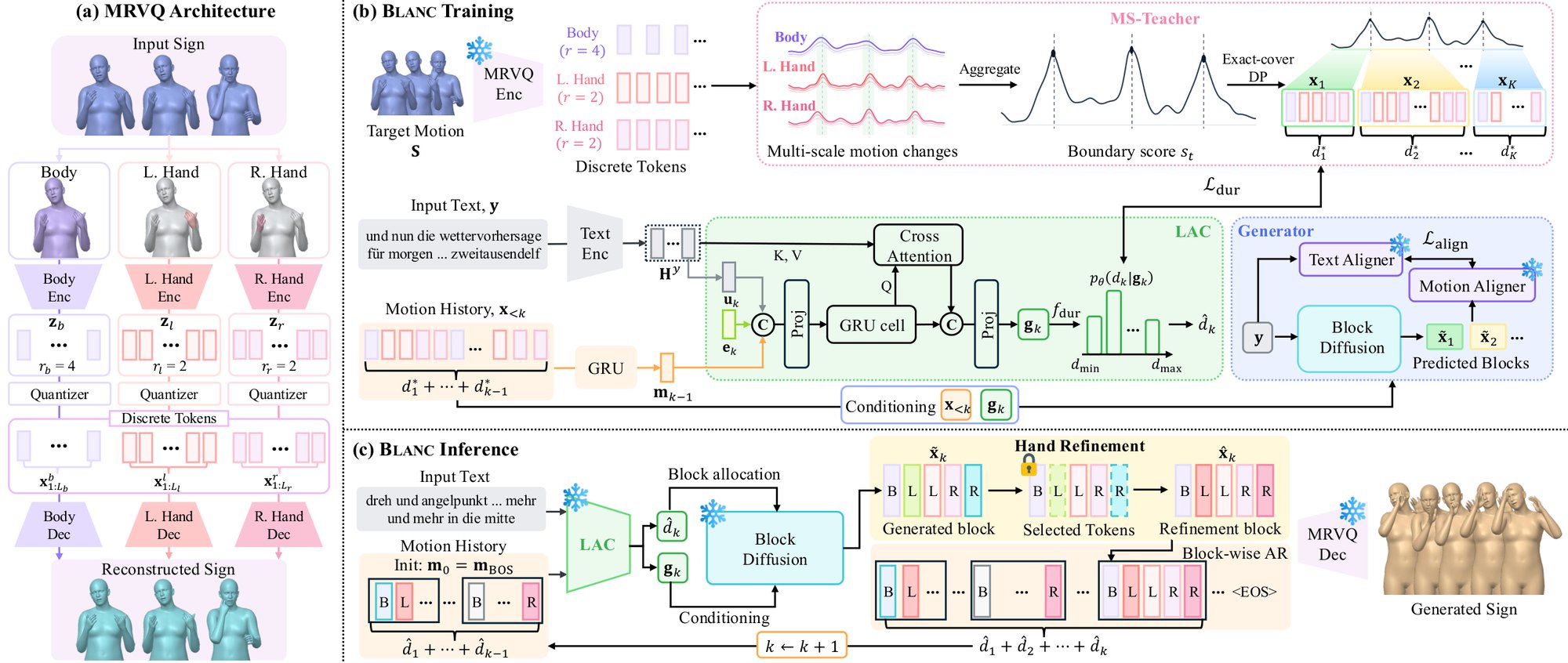
Overview of MRVQ architecture, BLANC training with the multi-scale teacher and LAC, and BLANC inference with adaptive blocks and hand refinement.
Overview. (a) MRVQ architecture for multi-rate motion tokenization. (b) Training pipeline of Blanc with motion-derived temporal supervision. (c) Inference with adaptive block generation and body-conditioned hand refinement.
Tokenizer

MRVQ: Multi-Rate Vector Quantizer

Separate VQ-VAEs encode the body (stride 4) and each hand (stride 2) into discrete streams, so hands keep twice the temporal resolution of the body with a compact token budget.

Where to split?

Multi-scale Teacher

Measures persistent changes in frozen MRVQ codebook embeddings across articulators and scales, then solves a bounded exact-cover DP to produce variable-length block targets. No gloss labels needed.

How long?

Latent Articulatory Clock

A causal controller that predicts the next block duration and sequence termination from remaining text semantics and generated motion history.

Inference

Body-conditioned Hand Refinement

Remasks the most uncertain hand tokens in each block and re-predicts them with the same generator, keeping body tokens fixed as articulatory context.

Results

Comparison with gloss-free SLP methods

Method PHOENIX-2014T CSL-Daily
DTW-PA-JPE โ†“DTW-JPE โ†“Back-Translation โ†‘ DTW-PA-JPE โ†“DTW-JPE โ†“Back-Translation โ†‘
BodyHandBodyHandBLEU-4ROUGE-L BodyHandBodyHandBLEU-4ROUGE-L
T2Mโ€ 36.543.6335.6924.120.315.9528.833.5830.9718.630.0010.80
MotionGPT8.221.708.319.075.6216.8810.052.199.8610.650.009.15
MoMask8.201.587.917.696.4419.8110.582.1510.519.610.5715.89
SOKE (no dict.)8.241.648.698.075.1323.869.941.779.638.702.6621.13
SignPRโ€ 7.871.877.677.431.049.8210.632.3710.759.720.2713.06
SignSparK (no KF)8.351.818.327.961.2110.089.832.169.178.780.3212.82
Blanc (w/o Refinement)7.571.497.317.019.5824.839.671.719.488.191.8618.52
Blanc7.581.487.337.009.8525.369.751.719.548.252.1319.05

Bold: best ยท Underline: second best ยท โ€  reproduced results.

Fixed vs. adaptive blocks

Block sizePHOENIX-2014TCSL-Daily
Body โ†“Hand โ†“BLEU-4 โ†‘Body โ†“Hand โ†“BLEU-4 โ†‘
Lโ€ฒ = 1 (AR)9.101.696.3711.142.010.68
Lโ€ฒ = 511.332.104.3715.172.590.98
Lโ€ฒ = 1011.792.234.1014.792.560.98
Lโ€ฒ = 2010.952.114.7614.532.561.18
Blanc7.581.489.859.751.712.13

Body and Hand report DTW-PA-JPE.

Tokenizer reconstruction

TokenizerPHOENIX-2014T โ†“CSL-Daily โ†“
BodyHandsBodyHands
MotionGPT29.785.6930.714.27
MoMask23.655.2725.074.12
SOKE25.634.6621.563.41
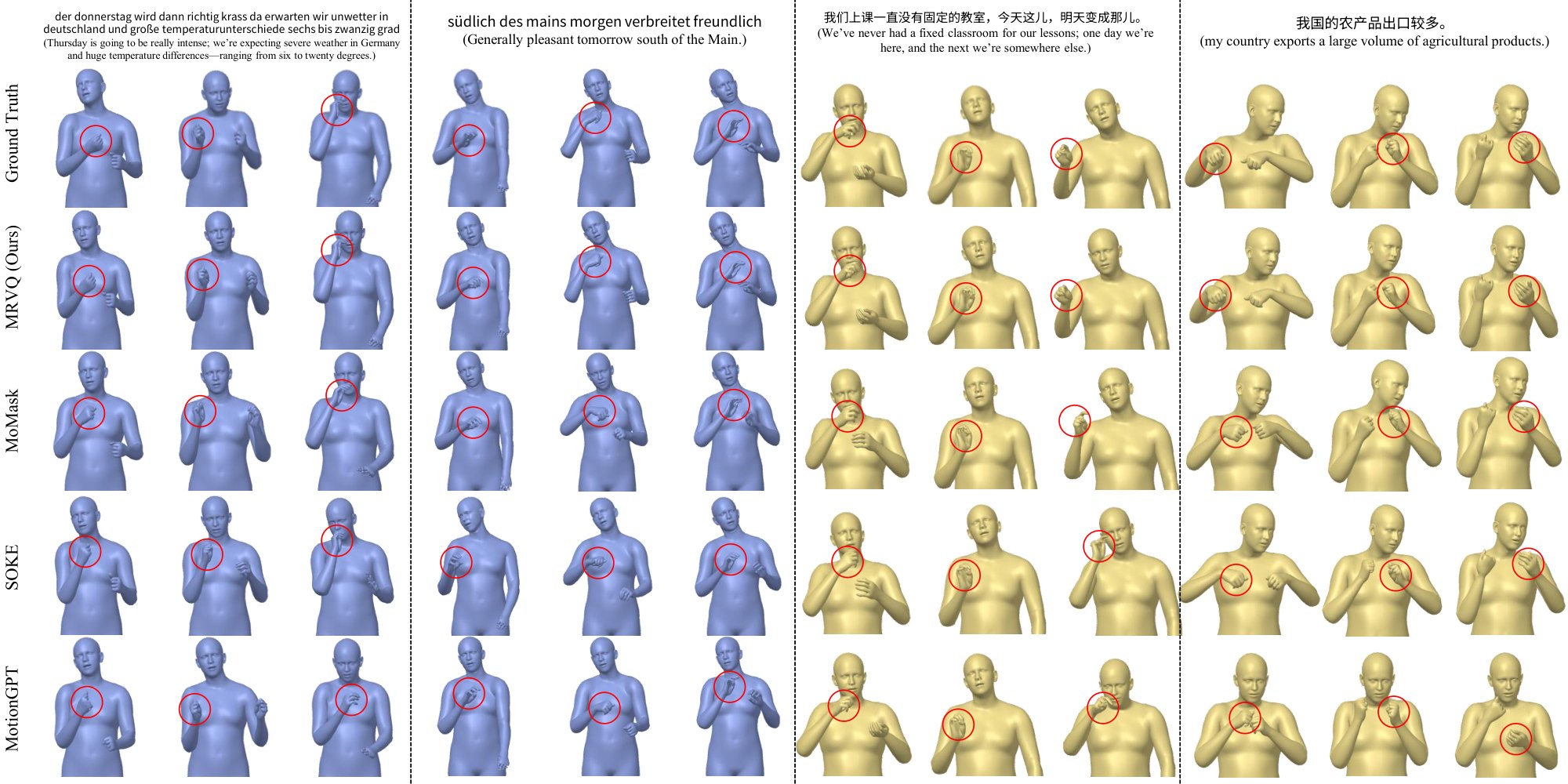
MRVQ (Ours)15.484.3711.803.06

PA-MPJPE of reconstructed motion.

Qualitative comparison

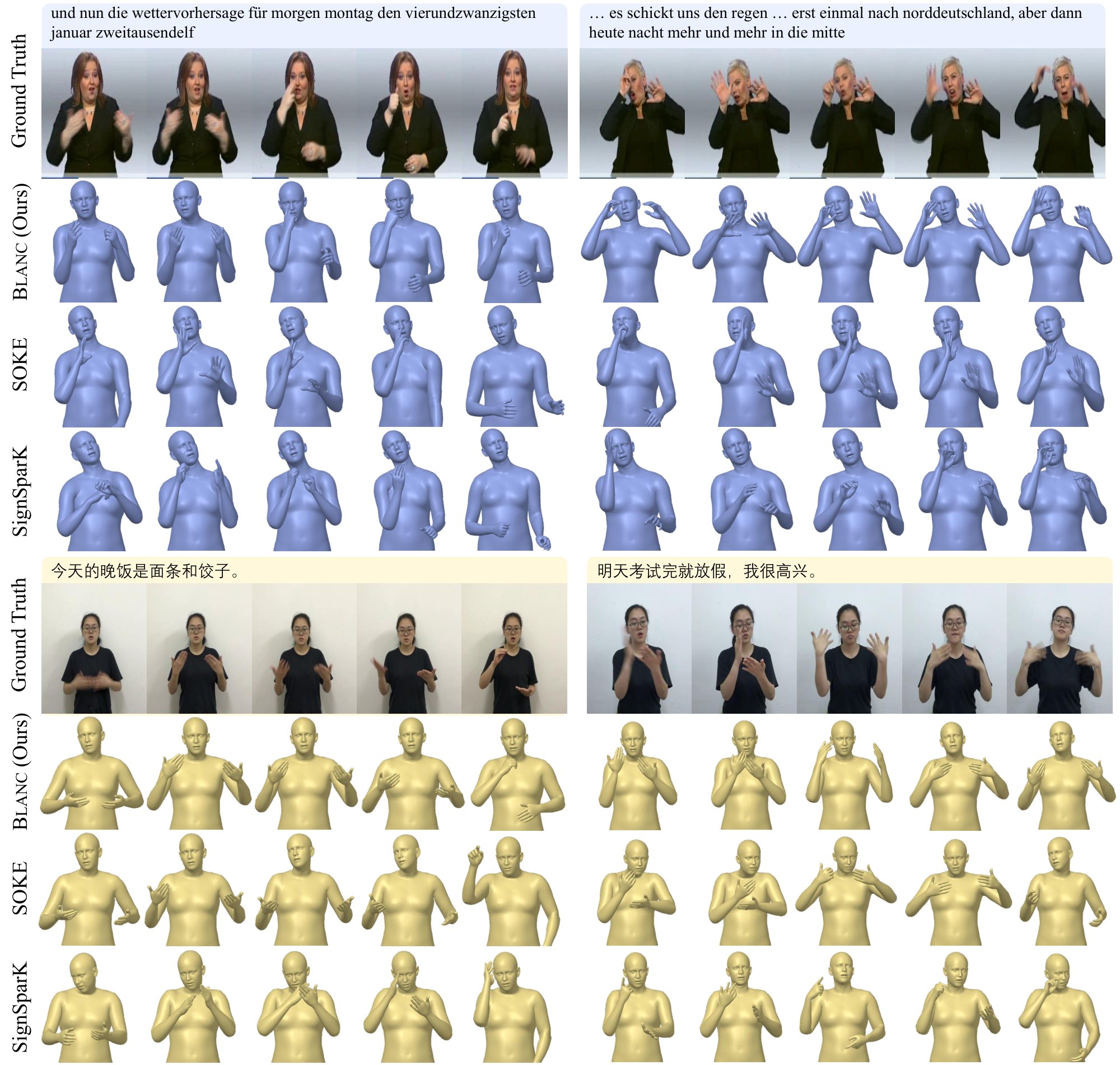
Qualitative comparison of BLANC, SOKE and SignSparK against ground truth on PHOENIX-2014T and CSL-Daily.
Ground truth vs. Blanc, SOKE, and SignSparK on PHOENIX-2014T (blue) and CSL-Daily (yellow).

BibTeX

@article{kim2026blanc,
  title   = {BLANC: Adaptive Temporal Scheduling for Sign Language Production},
  author  = {Kim, Youngmin and Hwang, Seoyeong and Hong, Sujung and Hwang, Seong Jae},
  journal = {arXiv preprint},
  year    = {2026}
}